 When you have spent most of your life in Detroit, it is easy to become pessimistic about its future. The city has been in steady decline for almost 50 years.
In the fifties, Detroit was home to almost two million residents living mostly in single-family houses in clean, safe neighborhoods. Most of America's automobiles were manufactured within the city in huge factories surrounded by those neighborhoods with the sturdy little houses where the factory workers lived.
Today, about 875,000 people live in Detroit, within the same physical boundaries as when twice that number lived in the fifties. In sections of the city, particularly on its lower East Side, acres of open fields stand where bustling neighborhoods once thrived. Sadly, the majority of the city's remaining housing stock is in a state of decline.
Certainly, there are neighborhoods that are holding on like Rosedale Park, the University District, Indian Village and the Lafayette Park area. And new condominiums and lofts continue to spring up in a decidely upbeat and reviving downtown. There is also the Riverfront walkway under construction spanning a five-mile stretch between the Ambassador and Belle Isle bridges. The Riverwalk is an impressive endeavor backed by the city's and Michigan's big business and big government and it will be a wonderful asset when completed in 2007.
But with Michigan's dead-last, sagging economy, Detroit's 14 percent unemployment rate, its ranking as the city with the most crime and greatest number of poor, is there any chance that Detroit can someday be a great city again? I think it can. But it will take some time, and some new ideas that have yet to see the light of day. Time is running out. Fortunately, community and corporate leaders and elected officials have thrown some new ideas on the table that have promise. Most recently, Wayne County Executive Robert Ficano unveiled a new plan for the expansion of Cobo Hall. We've been here before -- this is at least the fith plan for Cobo's expansion in the past 10 years. But this one has something extra going for it -- timing. Six regional nonprofit groups recently rolled out One D, a plan work together the next six months developing a supposedly implmentable regional plan for economic development and turnaround that will be presented at the Mackinac Conference in June 2007. Detroit Renaissance recently released its Road to Renaissance, an elaborate and detailed study with recommendations on how to revive Southeast Michigan and make it an economic force in the 21st century. So let's all roll up our sleeves and get busy. Meanwhile, I will be examining these proposals and getting back to you.
When you have spent most of your life in Detroit, it is easy to become pessimistic about its future. The city has been in steady decline for almost 50 years.
In the fifties, Detroit was home to almost two million residents living mostly in single-family houses in clean, safe neighborhoods. Most of America's automobiles were manufactured within the city in huge factories surrounded by those neighborhoods with the sturdy little houses where the factory workers lived.
Today, about 875,000 people live in Detroit, within the same physical boundaries as when twice that number lived in the fifties. In sections of the city, particularly on its lower East Side, acres of open fields stand where bustling neighborhoods once thrived. Sadly, the majority of the city's remaining housing stock is in a state of decline.
Certainly, there are neighborhoods that are holding on like Rosedale Park, the University District, Indian Village and the Lafayette Park area. And new condominiums and lofts continue to spring up in a decidely upbeat and reviving downtown. There is also the Riverfront walkway under construction spanning a five-mile stretch between the Ambassador and Belle Isle bridges. The Riverwalk is an impressive endeavor backed by the city's and Michigan's big business and big government and it will be a wonderful asset when completed in 2007.
But with Michigan's dead-last, sagging economy, Detroit's 14 percent unemployment rate, its ranking as the city with the most crime and greatest number of poor, is there any chance that Detroit can someday be a great city again? I think it can. But it will take some time, and some new ideas that have yet to see the light of day. Time is running out. Fortunately, community and corporate leaders and elected officials have thrown some new ideas on the table that have promise. Most recently, Wayne County Executive Robert Ficano unveiled a new plan for the expansion of Cobo Hall. We've been here before -- this is at least the fith plan for Cobo's expansion in the past 10 years. But this one has something extra going for it -- timing. Six regional nonprofit groups recently rolled out One D, a plan work together the next six months developing a supposedly implmentable regional plan for economic development and turnaround that will be presented at the Mackinac Conference in June 2007. Detroit Renaissance recently released its Road to Renaissance, an elaborate and detailed study with recommendations on how to revive Southeast Michigan and make it an economic force in the 21st century. So let's all roll up our sleeves and get busy. Meanwhile, I will be examining these proposals and getting back to you.Detroit Can Have a Bright Future, But the Clock is Ticking
When you have spent most of your life in Detroit, it is easy to become pessimistic about its future. The city has been in steady decline for almost 50 years.
In the fifties, Detroit was home to almost two million residents living mostly in single-family houses in clean, safe neighborhoods. Most of America's automobiles were manufactured within the city in huge factories surrounded by those neighborhoods with the sturdy little houses where the factory workers lived.
Today, about 875,000 people live in Detroit, within the same physical boundaries as when twice that number lived in the fifties. In sections of the city, particularly on its lower East Side, acres of open fields stand where bustling neighborhoods once thrived. Sadly, the majority of the city's remaining housing stock is in a state of decline.
Certainly, there are neighborhoods that are holding on like Rosedale Park, the University District, Indian Village and the Lafayette Park area. And new condominiums and lofts continue to spring up in a decidely upbeat and reviving downtown. There is also the Riverfront walkway under construction spanning a five-mile stretch between the Ambassador and Belle Isle bridges. The Riverwalk is an impressive endeavor backed by the city's and Michigan's big business and big government and it will be a wonderful asset when completed in 2007.
But with Michigan's dead-last, sagging economy, Detroit's 14 percent unemployment rate, its ranking as the city with the most crime and greatest number of poor, is there any chance that Detroit can someday be a great city again? I think it can. But it will take some time, and some new ideas that have yet to see the light of day. Time is running out. Fortunately, community and corporate leaders and elected officials have thrown some new ideas on the table that have promise. Most recently, Wayne County Executive Robert Ficano unveiled a new plan for the expansion of Cobo Hall. We've been here before -- this is at least the fith plan for Cobo's expansion in the past 10 years. But this one has something extra going for it -- timing. Six regional nonprofit groups recently rolled out One D, a plan work together the next six months developing a supposedly implmentable regional plan for economic development and turnaround that will be presented at the Mackinac Conference in June 2007. Detroit Renaissance recently released its Road to Renaissance, an elaborate and detailed study with recommendations on how to revive Southeast Michigan and make it an economic force in the 21st century. So let's all roll up our sleeves and get busy. Meanwhile, I will be examining these proposals and getting back to you.
Losing the Privacy Battle
Technology, for the most part, is a wonderful thing. It has made our work easier and our lives longer and more enjoyable and created vital new segments in our growing economy. But technology also has its dark side. One example is the electronic black box that auto manufacturers install in every new car for the purpose of gathering data in the event that the car crashes. One of the most vital pieces of information is how fast the car was traveling at the moment of impact. This is data that can assist the car companies in designing safer cars. And it allows the federal government to gather crash statistics that can be useful in traffic management.

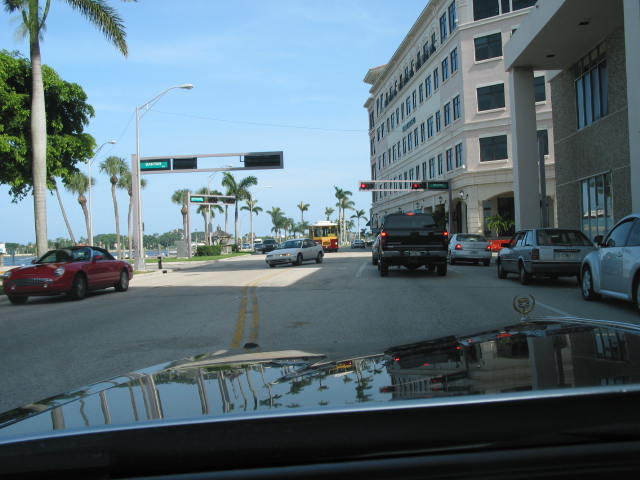
The black box can also provide a measure of safety when it is used to locate and assist a person in a car with a medical emergency. If your car conks out in the middle of the desert, the black box could save your life.
But the black box has a downside. It invades the privacy of the owner of any vehicle with a black box because the box was not an option when the owner purchased the car. Without knowing it, the surrenders his or privacy to provide crash data for the public good. For now, the data is considered confidential and the property of the car owner. However, judges have already determined that the box and its data can be subpoenaed as evidence against the car owner, creating situations where a defendant – through the data contained in his own black box – is testifying against himself in his own trial. Hoisted on his own petard, as they say.
The courts are not the only conspirators in this dangerous trend. The insurance companies – working closely with local and federal government – have access to the black box data as well. This means that if your black box records a pattern of excessive speed, your insurance rates could increase.
Already one major car rental company use the black box to monitor the speed at which the renters travel. Weeks after the car is returned the renter can receive additional charges on his credit card for a pattern of speeding.
The black box is typical of a trend in government and corporations that is chipping away at what little privacy we have left. Happy motoring.
What Do I Tell Them About the City?
As a Detroit resident, it's impossible to visit anyone in the suburbs without getting into a conversation about the city and having to answer questions about its overall health and future. It's as if I have to be an expert on the city, know everything about its politics, night life, neighborhoods and people. When I'm in these conversations with my suburban friends, I sometimes feel like a spy who slips in and out of Detroit to gather intelligence and report back to them on life in the troubled, dangerous city.
Most of these folks rarely come to the city, and when they do it's for a concert or a game, maybe a quick drink, then they hit the freeway for the run back home. Their beliefs about the city are formed by these occasional trips plus what they read in the newspapers and see on television. I believe that they truly want the city to succeed and wish it well, but they have no sense of ownership in its future.
When I find myself in these conversations I always feel conflicted about what to say. On one hand I see the city like so many do -- bleak and a lost cause. And on the other I see a city of promise and optimism. To paraphrase Detroit News columnist Betty DeRamus who paraphrases author Charles Dickens, I see Detroit as existing in the "best of times and the worst of times." Therein lies my conflict. Am I supposed to be a PR person for the city and talk about its promising economic development, new housing, newly-paved streets and new restaurants? Or do I give them a vicarious thrill and talk about the gunshots at night, the wall-to-wall blight, the three out four families without live-at-home fathers, and a 14 percent unemployment rate?
There was a time when I would say that I could walk through any Detroit neighborhood at two a.m. without fear of being harmed in any way. I would say this not to suggest that I was some daring, streetwise (white) guy, but to make the point that Detroit was really a safe city. But I don't think I can say that anymore. Neighborhoods that were once borderline ghetto have deteriorated significantly in the pasts five years into barely livable war zones.
Several weeks ago I drove through the city's near northeast side, near Dequinder and Six Mile. It was scary, and it was sad. The area is filled with side streets that are pockmarked with burned-out bungalows and unkempt empty lots. Young men hung out on street corners, in front of beer stores and on front porches, and they stared at me as I rode by, wondering perhaps whether I was a cop, landlord, or just another guy slumming.
Detroit's financial crisis is daunting. Recently its independent auditor Joe Harris said the city will go broke if dramatic cuts in employees and employee benefits are not made soon. He says the city's deficit will hit $336 million by June 2006 if nothing is done. The mayor claims the deficit is $79 million. Whatever the amount, the deficit is exacerbated by the steady flow of middle class families leaving the city.
According to the U.S. Census Bureau, nearly 200 persons leave the city every week. Since the city is 85 percent African-American, the white flight of previous decades has become black flight. The people leaving are middle and upper class taxpayers who are taking their city tax dollars and disposable income with them. The sad irony in this is that back in the day we fought and won the battle for equal housing. One unintended consequence of this victory is that now affluent blacks are leaving the city for the good schools and safety of the suburbs.
And there's the other Detroit. The Super Bowl's coming in January 2006 and and the city's host committee is doing a wonderful job preparing for it. I have lived downtown or near it for most of my life and it hasn't looked this good in 35 years. Every downtown street is freshly paved. A new Campius Marcius park with a skating rink, bandshell, French coffee shop and traffic circle have replaced old and drab Kennedy Square. The new Compuware skyscraper with a Hard Rock Cafe, Border's bookstore and other retail has brought hundreds of new employees and street life to the area.
Old buildings converted into pricey new lofts are now everywhere downtown. Harmonie Park with the toney Rhino restaurant is the new hot spot for the young and the restless (as well as the not-so-young and rested). Up the street, the Lions and Tigers play to capacity crowds in new world-class venues and the Detroit Athletic Club thrives as one of the finest and most prestigious private clubs in the nation.
Thanks to GM and others, our beautiful riverfront has finally been discovered and a five-mile riverwalk from the Ambassador Bridge to Belle Isle is taking shape. Soon a string of parks, a marina, Chene Park, a walking and jogging path, restaurants, condos, nightclubs and retail shops will stretch from bridge to bridge. (Mayor Coleman Young had this idea in the eighties but couldn't get the support to build it.) And all this is added to a dramatically improved and now user-friendly Renaissance Center.
So what do I tell my suburban friends when they ask how things are going in Detroit? I tell them the truth.
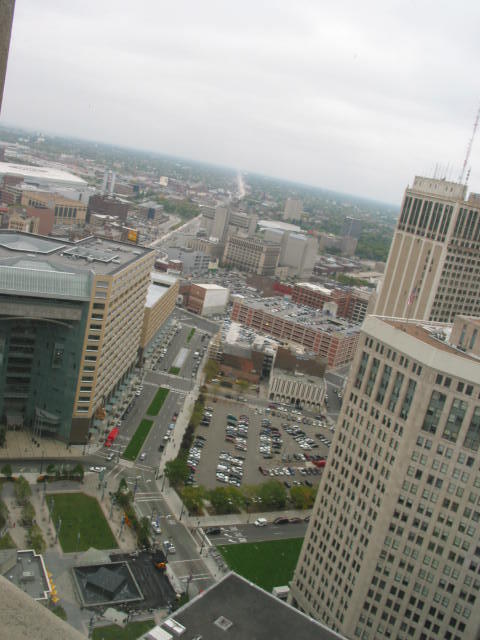
(Photo by Corbett Kid from his office in the Penobscot Building, downtown Detroit, looking northeast. The small ribbon running into the horizon is Gratiot Avenue.)
Funk Brother Hunter Honored with Big Jam Session

Bert's in the Marketplace was on full jam last night as literally hundreds of patrons passed through to honor the late Joe Hunter, a pivotal Motown musician who died in his Detroit home last week at 79. Hunter was considered the lead musician in the Funk Brothers, the group that played backup to all of the Motown groups of the sixties and gave the label its signature sound.
The packed house heard the music and singing of at least 20 different session players and singers who played and sang mostly soul and R&B songs of the sixties. Some of the cats did a great job with standards like "Mercy," and "Round Midnight."
While the jam session was going down, the annual Dirty Show was going full force next door at Bert's Marketplace Theatre. The show is a display of erotic, exotic and x-rated art and dance. Some 500 patrons passed through to engage in the titillations. It was my first time at the Dirty Show. Interesting, to say the least. What I liked most is seeing all the people downtown having a good time.
Either the Dirty Show patrons were all from the suburbs, or every white Detroiter attended the show, while the Hunter tribute next door was a mostly black audience. Nevertheless, patrons of both passed back and forth between events throughout the night making for an eclectic blend of nightlifers. A great scene, really. And good for Detroit.
"DreamGirls" Does Right by Detroit
 Jennifer Hudson carries film about singing group.
The most talked about film around town these days is "Dreamgirls", the film adaption of the 1981 Broadway musical based loosely on the intertwined stories of Mowtown Records and its most famous singing group, the Supremes. The story is set superficially in Detroit, almost as a bit player. As far as I could tell not a single scene was actually shot in Detroit, but overall the movie and its story put Detroit in a fair and accurate light. A non-Detroiter viewing this film will see a vibrant city, rich in texture, history and interesting people.
The film stars Beyonce Knowles, Eddie Murphy, Jamie Foxx and a small role for Danny Glover. They all perform admirably with a somewhat scattered storyline, but the the real show-stopper is Jennifer Hudson as Effie White, a character fashioned somewhat after Florence Ballard of the real Supremes. The performances, songs and production values are excellent. (What else would you expect from DreamWorks?) Be warned, though, that not a single Motown song is sung. All the music is original, written for the play and the movie.
I particularly enjoyed the scenes that take place in a Detroit night club in the final third of the story, when Effie starts to make her singing comeback. The sights and sounds of these club scenes evoked a powerful memory of the many intimate clubs with tables for two or four in dark, smoky rooms once scattered around town, but mostly gone today.
In all, not a great flick, but a very good one. Just get a big tub of popcorn, sit back and enjoy a movie filled with lush sets, lavish costumes, interesting characters, and feel good about Detroit.
And the Beat Goes On

If this wasn't so sad, it would be funny. The fourth homicide of the week occurred today on the city's west side in an apparent armed hold-up. The story just hit the Detroit News Website. See the next post, below.
Killings Bad Timing

I don't want to turn this blog into a police blotter, but the recent killings of three people in downtown Detroit this week could not have come at a worse time. Monday, two employees of Chelio's Chili restaurant were stabbed to death by a disgruntled employee who was later apprehended. Wednesday, a woman was shot and killed near the Second Baptist Church of Detroit, an historical landmark in Greektown. (The "good news" is that the killings were not random; the assailants knew their victims.)
I say they couldn't have come at a worse time because the national and international media is in town for two weeks to cover the International Auto Show at the Cobo Exposition Center and we know how a few of them love to bash Detroit. Once again Detroit will probably get a black eye in the media as being the "murder capital" of the U.S. Unfortunately, FBI statistics will bear this out.
Fortunately, as this Detroit News article on the killings points out, downtown Detroit is one of the safest neighborhoods in all of the America, and I can vouch for that. I have lived in downtown Detroit most of my adult life and except for the occasional car theft or home invasion that happen routinely in the suburbs, living downtown is very safe and enjoyable.
Auto Show Sparks Cobo Expansion Talk Again
 The annual Detroit International Auto Show is coming to town next week and once again there's buzz about the need to expand Cobo Exposition Center or lose the show to another venue.
The auto show is one of Detroit's premiere events, drawing international attention and millions of dollars in revenue and its loss would deal a serious blow to the city. Mayor Kwame Kilpatrick and Wayne County Executive Robert Ficano each have a different plan on the table but as always, the big issue is who will pay for it. Plans to expand Cobo have been around since Coleman Young was mayor (at least), so don't hold your breath.
Because it's a regional facility most agree that the cost of expansion should be shared by the three counties of Metro Detroit, but nobody can agree on a formula to make that happen. Cobo was expanded and upgraded once, I believe in the eighties.
Subscribe to:
Posts (Atom)