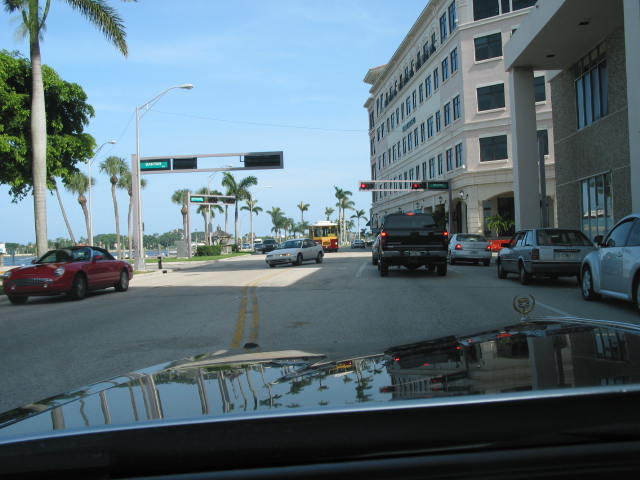
DDOT Seeking Public Input on 3 Rapid Transit Lines

The Detroit Department of Transportation will host four public meetings this week to ascertain public support for three possible rapid transit routes. The options, all of which include a three-mile stretch of Woodward between downtown and New Center, are:

Woodward to Eight Mile; Michigan Avenue to Dearborn, near Fairlane Mall and University of Michigan-Dearborn; and Gratiot to Eight Mile.

These three alignments were deemed worthy of further study for several reasons, including public support at an earlier round of public hearings, population, housing and employment density, major destinations, traffic volume, bus ridership, and concentration of car-less households. Modes being evaluated include bus rapid transit, light rail and upgraded traditional bus service.

The public meetings are being conducted under the auspices of the Detroit Transit Options for Growth Study (DTOGS) and are a step in the Federal Transit Authority-mandated process that must be followed in order to apply for federal funding.

DTOGS is expected to be complete by the end of the year, at which time the FTA will receive a recommended alignment and mode.

Each meeting will begin with an hour-long open house that will be followed by a presentation and public comments. The meeting schedule is:

Wednesday, July 25 from 11 a.m. to 2 p.m. at the Guardian Building

Wednesday, July 25 from 5 to 8 p.m. at Wayne State University's Welcome Center

Thursday, July 26 from 5 to 8 p.m. at Wayne County Community College's Cooper Community Center

Saturday, July 28 from 10 a.m. to 1 p.m. at Ford Community and Performing Arts Center in Dearborn

Urban Agricultural Growing in Detroit

What do we do with the open spaces of Detroit? Of its 120 square miles of land, nearly 40 square miles are now open spaces -- the byproduct of abandonment of the city. One use of this land is urban agricultural. There's a group that's been working at this since 1998 and today is known as Earth Works Garden . Today, some 300 agricultural projects exist within the city of Detroit. This is a national movement that is part environmental and part urban reclamation. Regardless of your thoughts on oil, its rising cost is a certainty and perhaps urban farming will be one part of Detroit's future.

Boblo Boat Comes Home

One of Detroit's storied Bob-Lo Boats, the S.S. Ste. Claire was towed from Cleveland to Detroit recently to be part of the festivities at the opening of the city's new Riverwalk. Owners are attempting to restore the boat to near originality. You can tour the boat for a donation of $5 at the foot of Rivard St., near Chene Park.

Beating Crime Requires Strong Families and Neighborhoods

Adolph Mungo, Michigan political consultant and general observer of the Detroit scene, recently wrote an op-ed piece for the Detroit News that really nails the crime situation in Detroit. Mungo says that the real problem there are so many killings and other major crimes in our city is that: "Criminals are not afraid of the police and, worst of all, many of them have more firepower than the police." (I suppose it's also safe to say that criminals are not afraid of their victims.)

I agree with this observation and others in Mungo's article. However, Mungo fails to address the core problem. We are now on our second generation of inner city youth who have grown up without any parental control or a decent family life where two parents instilled family and community values. They drop out of school, mimic the thug life, join gangs, get illegal guns. As a result we have criminals running wild, attacking at will. Police can only respond after the fact.
The community does nothing about it. Oh, there are marches, and neighborhood meetings and sermons on Sunday. But the community continues to look to the police, the mayor's office, and other government agencies and institutions to solve the problem, when the solution lies within each and everyone of us as individuals to take responsibility for our children, our neighborhoods and our city. Too many Detroiters are accustomed to a culture wherein people wait around for "them" to fix the problem --"When are they going to do something about this crime?"
The police get blamed for their inability to stop criminal behavior that has become normalized in our city. According to FBI statistics, Detroit has the highest crime rate and murder rate per capita than any other major city. The police spend most of their time running from one crime scene to the next, rather than working to prevent crime. They can crack down in a certain area and cut crime for a minute in that area. But soon they will have to leave that area to crack down in another, and crime goes back up in the first area.
Community activists will tell us that the community's lack of any substantive response to crime is the result of poverty which creates single-parent households and other related issues, and certainly that's a part of it. But until citizens unite and as Mungo says, "rise up against crime," the killings and robberies will continue.

End of Blackness

Several years ago I read The End of Blackness by Debra Dickerson and was impressed by her facile and intellectual writing style and the force of her message. In her book Dickerson concludes that we’ve gotten all that we are going to get from whites in terms of apology or concession, that through begrudging white acquiescence and black determination, blacks have made tremendous strides in the past 45 years since the Civil Rights Movement, that racism is not dead but has morphed into a new, less virulent strain that while still harmful no longer prevents blacks from achievement, and most importantly, that blacks should stop looking to whites to solve their problems but rather find solutions within themselves as individuals and from within their own community.
I pulled Blackness off the shelf recently and began to read it again, as I do with most books that I really enjoy. I expected to savor again some of the lucid, clear points that Dickerson makes in this very insightful and pragmatic writing. But something is happening this time around. I’m picking up a vibe that I’m not sure whether I missed the first time, or that my views have since shifted – probably to the right but still left of center – since I last read the book and I’m reading it now through a different prism. From this reading of Blackness I’m feeling from her an edge, an anger, even a meanness that I didn’t feel before.
I know that a black person writing meanly about white people should come as no surprise, and is with justification. I’m used to taking a beating, as a white, reading black literature of the fifties, sixties and later, about black oppression and victimization, about the horrors of slavery and Jim Crow and overt racism, about how a white can take no comfort in racial ignorance, that all whites are guilty, actively or passively, in America’s great Original Sin. I fully understand, though no longer fully accept, that today's white cannot wash his hands of the racism of centuries ago by simply saying I wasn’t there. Such readings for me have always had a purging effect, as if reading the work of an angry black author was a cleansing, washing away at least some of the white guilt, and possibly – though rarely – showing me the way to salvation from the racial swamp that we all have to muck around in.
Writings like Dickerson’s always leave me perplexed. As a white reader you take a real pounding from constant reminders of how your being white ties you permanently to our nation’s treatment of blacks first as as slaves, then victims of the Jim Crow era, followed by being the recipients of the various forms of overt and invidious racism of the 20th century up to today.
The black writers remind a white person how barren is his soul of love, how hopelessly egocentric and Eurocentric he is. What’s perplexing is that nothing concrete is offered as to how whites can help. I believe that the vast majority of whites want to do the right thing when it comes to helping other Americans in need, regardless of race. But whites today don't know what to do when it comes to being part of the race solution, if there even is one, and blacks have nothing substantive to offer them as to how to help. (Dickerson at least offers a strategy for blacks to follow.)
Most of us have come to recognize that blacks historically have been treated egregiously and, we are willing to take part in something to make things right. America has been trying to do that for the past 45 years. First, the black-led Civil Rights Movement blew the doors off old-school racism, prejudice and discrimination. Then President Johnson ushered in the $7 trillion Great Society that harmed more than helped black America, destroying the black family and black manhood with open-ended welfare. Maybe whites have not embraced the change, but we have accepted it as inevitable, and we either stepped aside and let it happen, or jumped in and helped to bring about the change. After all, the vast majority of the social workers and social engineers of the Great Society where white liberals, motivated by a blend of white guilt and a sincere, if naive, desire to do good.
Dickerson thinks that because American culture is out there, highly visible for all to see on television, film, art, and the Internet that blacks know what whites thinking and feeling. Black race writers always see whites as transparent, an easy read. They still rely on the dated model of the old days, when blacks worked in the midst of white folks but were invisible as slaves, domestics, and menial laborers. And whites carried on with their lives in the presence of these blacks as if they were invisible. Or some blacks became close friends or confidantes and were brought in on the nuances of white life. But those days are past. Today, all our shit is hanging out there – black, white, Latino, whoever. And all of us from all cultures and groups in America know, or have access to, what the others are thinking, or how they feel on a certain topic. There are no more racial secrets in America. We’re the Mulatto Nation now.

Marketing Overkill Has Taken Me Out of the Game

I have been a loyal fan of the Detroit Lions, Pistons, Red Wings and Tigers since I was a kid growing up on Detroit's East Side, and will remain loyal to these teams for the rest of my life.

But with the exception of a few times a year, I have stopped attending games and do all of my sports-watching through television.

My not attending games anymore has nothing to do with the price of tickets, the hassles of parking, or the logistics of going to a game. In fact, I live downtown and can walk to Comerica Park, Ford Field and the Joe Louis Arena. Nor am I one of those fans who thinks athletes are overpaid. I believe that you are worth what you can get.

The fact that three of the four Detroit teams play in publicly subsidized venues (the Pistons paid for the entire cost of the Palace) irritates me, but not to the point that I will not attend a game because of it. My attendance at pro sports games in Detroit has dropped for three reasons.

One, the improvement in television technology makes watching a game on TV a real kick. The large, flat-screen, high-definition television (HDTV) is a truly wonderous invention and tailor-made for watching sporting events. Game coverage now has remote cameras at just about every angle, including an overhead camera that follows the action from above as the players move down the football field or basketball court. Cameras are now in the dugout, on the sidelines, courtside, everywhere. The TV producer in the booth is cutting constantly from camera to camera. Between the action we can watch 'em spit, scratch, cuss, bump fists, distribute high fives, the whole deal, replete with constantly-streaming graphics, player stats and old takes from prior games.

Two, the growth and popularity of sports bars provides a wide choice of comfortable and enjoyable venues where you can watch a game with a hundred or so other fans and soak in the excitement and noise of a crowd rooting for the home team. You get to moan, boo, cheer and holler with the crowd and "get into" the game just as if you are actually there. You also get to watch all the instant replays in regular and slo-mo and of course, the beer is cold, the food is hot, and there are no long lines at the bar or the restrooms.
One of my favorite tricks is to walk downtown on the night or day of the game and slip into Chelio's or Coaches Corner sports bars and restaurants. I get the feel and excitement of the game crowd on the streets and in the bar before and after the game. Sometimes I will drive to Royal Oak for a game and soak up the street life on Main Street.

But most of all, I've stopped going to games because of the nosie and the marketing overkill that has taken over pro games. (College sports have been professionalized and over-marketed, but still maintain a purity and tradition that I enjoy.) This is the main reason I have been shying away from actually going to the games -- paricularly Lions and Pistons games.
The Palace of Auburn Hills and Ford Field are beautiful facilities, designed to meet every need and pleasure of the fan. However both venues annoy me with their public adress systems. I don't mind so much the loud music during breaks in the action as I do the constant intrusion of music and sounds into the actual game itself. I also hate the between-the-action promos like the Dunkin' Donut race at Lions games. With all the hype, I miss hearing the crashing of pads and the grunts of players, the squeaking of basketball shoes, the players hollering for the ball, and of course -- how could I forget -- "the crack of the bat."
The worst invention was the thunderstick. They have almost ruined NBA playoff basketball. Thank God, Major League Baseball banned thundersticks from the playoff games. The Red Wings games suffer from some of the same nosie pollution, but at least you can still hear the players crashing the boards and their skates shaving the ice.
I'm not yet so much the old fogey to say I'll never attend another pro game. There are still moments, in spite of all the manufactured hype, when there's nothing more exciting than when the Pistons break out of their timeout huddle to the deafening roar of the crowd and blare of loud music. I guess I'll just have to bring my earplugs.

Detroit Can Have a Bright Future, But the Clock is Ticking

When you have spent most of your life in Detroit, it is easy to become pessimistic about its future. The city has been in steady decline for almost 50 years. In the fifties, Detroit was home to almost two million residents living mostly in single-family houses in clean, safe neighborhoods. Most of America's automobiles were manufactured within the city in huge factories surrounded by those neighborhoods with the sturdy little houses where the factory workers lived. Today, about 875,000 people live in Detroit, within the same physical boundaries as when twice that number lived in the fifties. In sections of the city, particularly on its lower East Side, acres of open fields stand where bustling neighborhoods once thrived. Sadly, the majority of the city's remaining housing stock is in a state of decline. Certainly, there are neighborhoods that are holding on like Rosedale Park, the University District, Indian Village and the Lafayette Park area. And new condominiums and lofts continue to spring up in a decidely upbeat and reviving downtown. There is also the Riverfront walkway under construction spanning a five-mile stretch between the Ambassador and Belle Isle bridges. The Riverwalk is an impressive endeavor backed by the city's and Michigan's big business and big government and it will be a wonderful asset when completed in 2007. But with Michigan's dead-last, sagging economy, Detroit's 14 percent unemployment rate, its ranking as the city with the most crime and greatest number of poor, is there any chance that Detroit can someday be a great city again? I think it can. But it will take some time, and some new ideas that have yet to see the light of day. Time is running out.
Fortunately, community and corporate leaders and elected officials have thrown some new ideas on the table that have promise. Most recently, Wayne County Executive Robert Ficano unveiled a new plan for the expansion of Cobo Hall. We've been here before -- this is at least the fith plan for Cobo's expansion in the past 10 years. But this one has something extra going for it -- timing.
Six regional nonprofit groups recently rolled out One D, a plan work together the next six months developing a supposedly implmentable regional plan for economic development and turnaround that will be presented at the Mackinac Conference in June 2007.
Detroit Renaissance recently released its Road to Renaissance, an elaborate and detailed study with recommendations on how to revive Southeast Michigan and make it an economic force in the 21st century. So let's all roll up our sleeves and get busy.
Meanwhile, I will be examining these proposals and getting back to you.

Losing the Privacy Battle

Technology, for the most part, is a wonderful thing. It has made our work easier and our lives longer and more enjoyable and created vital new segments in our growing economy. But technology also has its dark side. One example is the electronic black box that auto manufacturers install in every new car for the purpose of gathering data in the event that the car crashes. One of the most vital pieces of information is how fast the car was traveling at the moment of impact. This is data that can assist the car companies in designing safer cars. And it allows the federal government to gather crash statistics that can be useful in traffic management.

The black box can also provide a measure of safety when it is used to locate and assist a person in a car with a medical emergency. If your car conks out in the middle of the desert, the black box could save your life.

But the black box has a downside. It invades the privacy of the owner of any vehicle with a black box because the box was not an option when the owner purchased the car. Without knowing it, the surrenders his or privacy to provide crash data for the public good. For now, the data is considered confidential and the property of the car owner. However, judges have already determined that the box and its data can be subpoenaed as evidence against the car owner, creating situations where a defendant – through the data contained in his own black box – is testifying against himself in his own trial. Hoisted on his own petard, as they say.

The courts are not the only conspirators in this dangerous trend. The insurance companies – working closely with local and federal government – have access to the black box data as well. This means that if your black box records a pattern of excessive speed, your insurance rates could increase.

Already one major car rental company use the black box to monitor the speed at which the renters travel. Weeks after the car is returned the renter can receive additional charges on his credit card for a pattern of speeding.

The black box is typical of a trend in government and corporations that is chipping away at what little privacy we have left. Happy motoring.